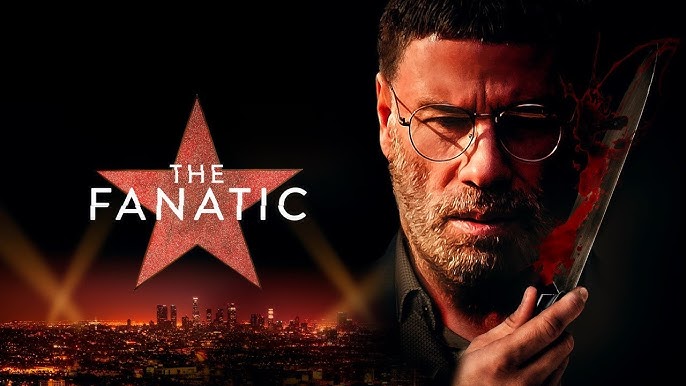
There has always been a direct correlation between film and rock and roll. It seems every actor has a music project so it’s only fitting that every rock and roller wants to have a movie. Whether it’s David Bowie falling to Earth, Henry Rollins badgering Keanu Reeves in a technothriller, or Rob Zombie remaking his favorite classic films into…less classic films, this intersectionality is seemingly everywhere. So, it should come as no surprise that Limp Bizkit frontman Fred Durst has found a second life as a film director. Whereas Zombie’s films have proven divisive, Durst’s third film, The Fanatic, starring John Travolta and Devon Sawa, has the distinction of being universally accepted — as a movie so bad that it’s an absolute must-see.
What Is ‘The Fanatic’ About?
The Fanatic stars John Travolta as Moose, an obsessed fanboy who inexplicably resides alone in Hollywood, making his living as a street performer and spending all of his money on autographs and collectibles. He is encouraged in his fandom by his paparazzo friend Leah, played by Ana Golja, who informs him of the “Star Map App” in a lapse of judgment. This error sends Moose on a collision course with his idol, Hunter Dunbar (Devon Sawa). Dunbar is a collection of ego and bad decisions, swimming through a limbo of separation and single parenting after a string of marginally successful genre hits that garnered him a particular kind of fan. Moose, the epitome of that particular kind of fan, relishes the opportunity to get an expensive prop vest signed at the local memorabilia shop where Dunbar is signing his cash grab book. When a custody misunderstanding cuts the signing event short, Moose accosts his hero, overstepping the social contract between fan and celebrity. The timing couldn’t be worse, and it raises Dunbar’s ire, who responds roughly. From this first meeting, the two principles continue to intersect, the tension between them boiling, turning them each into horrible versions of themselves that spin and clack like billiard balls over the dark felt of Sunset Boulevard and the Hollywood Hills.
The Fanatic was released in theaters in August 2019 for a limited one-week theatrical run, raking in $3,153 on its opening day, cementing it as a flop. Critical response was unkind, and the film currently stands at 4.1/10 on IMDb and holds a 15% rating on Rotten Tomatoes. Interestingly, the film registers currently at a 56% approval rating on Google Reviews, telling a markedly different story. One could venture that when the film was first released it fell upon a self-perpetuating tornado of negative reviews. Enough people chose to hate the film that it sparked interest, catching more viewers. Soon enough, a counterculture rose up to voice opposition, making a case for the film’s merits. So is it just a bad movie, a so-bad-it’s-good movie, or is it actually a good movie?
Is ‘The Fanatic’ a Bad Movie?
Fred Durst (yes, that Fred Durst) co-wrote and directed this thriller about a stalker. John Travolta (left), stars as the fanatic and Devon Sawa (right), stars as his movie star prey.
The Fanatic has been accused of being tone-deaf, and one could easily see that argument given fuel. While promoting the film, Travolta was quoted as saying that Moose is “on the spectrum,” and given the end result of the film, it appears that Durst and Travolta chose the briefest shorthand to express that. The film plays like “Rain Man meets Taxi Driver,’ as suggested by RogerEbert.com critic Brian Tallerico. Travolta affects tics such as rocking in place or smelling his ears while blurring social norms and expressing a general disconnect from the reality around him. He feels he must frequently assert that he is not stupid, as he often feels he is perceived this way. His social shortcomings are prevalent throughout the film, often oversharing, overstepping, or generally misunderstanding his interactions.
Even his appearance is engineered to reflect an otherness about him, though it is never explicitly stated in the film. Leah’s unnecessary narration describes him early on as “unbreakable,” which is something of a temptation of fate; a damning wink to the rest of the film. It’s evident that she is compassionate and protective towards Moose but her unwillingness to treat him with the sensitivity that he requires sets him on a path that he’s ill-prepared to traverse. In the film’s choice to show and not tell, the audience is actually at a disadvantage as we are unsure how to measure our response to Moose’s treatment throughout the film. He’s clearly a sympathetic character to a point but without a distinct definition of what lines he’s aware of, the viewer is unequipped to react appropriately when he obliterates them.
In addition to its deafness of tone, the film’s further detractions are the superfluous narration, the “confusing” ending, and the lack of a clear protagonist and antagonist. Furthermore, there is a direct reference to Limp Bizkit in the film, a non-sequitur scene wherein Hunter Dunbar is in his car with his son Danny and makes mention of the song playing on the stereo. He name-checks the band, turns it up louder, and mentions it’s “Hot!” It’s a moment that takes the average viewer seeking escapism out of the experience.
John Travolta Ditches His Cool for ‘The Fanatic’
Fred Durst, John Travolta, Devon Sawa, and Ana Golja all attended a screening of the film at a SAG AFTRA Foundation and participated in a Q & A afterward moderated by Variety’s Jenelle Riley in which all of them earnestly discussed the film as an endeavor they were genuinely honored to present. Very few filmmakers, with the exception of perhaps Lloyd Kaufman or John Waters, take the time and money to make a film that they believe will disgust, alienate, or fail to resonate with their audiences. Most filmmakers, one has to believe, want to make good movies. John Travolta, one would hope, wants to make a good movie. Travolta was king of the 70s and 80s because he was rich with the currency of cool, something he appeared to lose when he did films like Look Who’s Talking Too or, even worse, Look Who’s Talking Now. When Quentin Tarantino revived that cool credit, Travolta leveraged it into a second coming. One would think that being cool would be the most important thing to Travolta once he’d been cast out of its light for a spell, but he proved that wasn’t the case when he did Hairspray. Here, he doubles down on that conviction: Moose is decidedly not cool.
Devon Sawa told Screen Rant’s Zak Wojnar “I had to fight my ass off for this film. And I did it because I knew […] I had to get it.” The cast, the writer/director, and the whole crew believed in this film. That kind of dedication deserves to be met halfway by the audience. The meta-commentary is at times brilliant. Many may recall Sawa played the titular “Stan” in the Eminem video from 2000 about a deranged fan who takes things too far. How fitting it is in this iteration that he finds himself on the other end of the narrative.
The Intention of ‘The Fanatic’ is What Makes it Worthwhile
Filmmaking is about intention — nothing gets to the screen that is without purpose. The sum of this film’s parts work well together and the intention is apparent (with the exception of the narration). The animated interstitials (courtesy of Limp Bizkit guitarist Wes Borland), the affecting score, the gorgeous photography throughout, and even the conscious decision to obscure the line between protagonist and antagonist. What some may view as a poor decision could actually be seen as a calculated depiction of the moral ambiguity of us all, the harsh truth that the heroes and villains don’t wear white or black hats to designate their alignment. What viewers are treated to is an earnest film trying to tell an engaging story.
This analysis has purposely avoided spoiling the film, but a cursory glance at the box art will let the viewer know that the film takes a dark turn, and our beloved, misunderstood Moose becomes something of a villain during its runtime. Past that, this film is truly a work that has to be seen to be believed. It’s a strange combination of a tired trope with completely unexpected story beats — a story we’ve seen a hundred times go down dark tunnels we didn’t know existed. It is at the same time precisely what one would expect upon hearing “Limp Bizkit made a movie” yet filled with such unique choices that one is left wondering what they saw… and clamoring to talk to someone about it. It’s surprisingly even more foreign propped up next to the filmmaker’s other feature films: The Education of Charlie Banks and The Longshots. Durst has worked with Jesse Eisenberg, Jason Ritter, Sebastian Stan, and Ice Cube. He’s been behind the camera since 1998, so to delineate Fred Durst as an amateur director is to discount the real work he’s done. The Fanatic is a technically fine film with earnest performances, an engaging script, and a final act that allows the viewer to answer unequivocally for themselves: is this Travolta’s One Hour Photo? Or is this movie the next The Room? Midnight cinemas may answer this question for us in a few years’ time.
Eric McClanahan, originally published at Collider.com, on 2023, Oct. 17
In the fall of 1994, I was a junior in high school, while my older brother was a senior. We lived in a rural area of Southeast Texas, far removed from what most might call civilization. There were cows, but that’s about as advanced as the intelligent life got that far out. On a warm day towards the end of September, I went to rouse my brother from what I supposed was an after-school nap before heading off to his night job at a burger joint in the neighboring city. When I didn’t find him in his room, I looked outside. I found him in the backyard. He was lying on the foundation of a house my father was building. At his feet was a bible, with a verse underlined (a psalm I no longer recall) and a note stuck inside the pages. He had blown the back of his head off with a shotgun; blood was everywhere. I spoke to his body for several minutes before my stepmother’s voice behind me brought me to realize what I knew.
I’ve never been the same.
ALL MY PUNY SORROWS is a surprising dramedy adapted from the bestseller by Miriam Toews by director Michael McGowan. It deals with multigenerational trauma in a Mennonite family in Southern Canada. The two sisters at the crux of the film are both professional artists; one a concert pianist and the other a novelist. They speak, literally, in poetry.
Check out the trailer:
The film is a masterpiece; quiet, funny, and poignant, showcasing powerful performances over several generations of the Von Reisen family. Allison Pill (SCOTT PILGRIM VS THE WORLD, HBO’s “The Newsroom”) is captivating as Yoli, the younger sister to Elfie, played by Sarah Gadon (Amazons’ “11.22.63.”, Hulu’s “Castle Rock”). Both actresses give a weighty realism to the opposing views of survival in the face of crushing depression. Their anchor is their mother Lottie, played with devastating gravity by Mare Winningham (TURNER & HOOCH, ST. ELMO’S FIRE). Rounding out the family with varying levels of snark and care are Amybeth McNulty (Netflix’s “Stranger Things”) as Yoli’s daughter Nora and Mimi Kuzyk (“Blue Murder”, “The Chris Isaak Show”) as fiery Aunt Tina. Each of these actresses deliver performances that make the poetry of their dialogue believable and unpretentious, despite the script reading like an MFA thesis.
I got to speak with both screenwriter/director Michael McGowan and actress Allison Pill about the film. We discussed the conversations within the film as well as those which it should hope to spark, as well as the dynamite Donal Logue (THE TAO OF STEVE, BLADE), the potential backlash at the privilege and class prominent in the film, and, to finish on a high note, the incomparable and timeless SCOTT PILGRIM VS THE WORLD.
Michael McGowan – Hey, how are you, Eric?
Eric McClanahan – I’m well, how are you?
MM – I’m good, thank you.
EM – Fantastic! So, we’re talking about ALL MY PUNY SORROWS, which you adapted from the novel as a screenplay and directed. So, let’s start at the beginning: what made you decide to adapt this novel into a screenplay? What about this work spoke to you?
MM – Well I loved the novel and I felt like it had dealt with suicide in a way I hadn’t seen before. I also thought because it was based on Miriam’s [Toews,the author of ALL MY PUNY SORROWS] own lived experience, though it was a novel it was essentially true in so many ways; that gave it a credibility. And also there were three incredible roles that she had written and I thought we could punch above our weight with casting if we got lucky.
EM – I can see that, and you very much did get lucky. The performances by those core three are so amazing. Let’s start with Sarah Gadon; how did you get her onboard?
MM – Well, it’s interesting. We’re both Canadian and it’s kind of a small community. I’d actually met her in LA a few years earlier to talk to her about it. She’d read the draft and had some good notes about it which was fantastic. I’d always thought of her as an Elfie and not a Yoli, so it wasn’t as though I could make an offer to her straightaway as it would hinge on Yoli’s age to determine who the others would be. Then we had a great casting director, Heidi Levitt out of LA, who really raised the profile of the script as we were getting a lot of interesting actors that we were looking at. Then when Allison [Pill] read it and loved it, it was an easy decision, because I’m a huge fan of her work and she’s so smart about things. She completely got the character. So once we got her, and as Sarah was already sort of involved, we quickly went to Sarah, and then looking for the Lottie character, it was an easy fit with Mare [Winningham], so it all came together rather quickly. But it sort of all hinged on Allison coming aboard.
EM – I really appreciated the inclusion of Donal Logue in the cast. I’ve been a fan for a long time, but I’ve never seen him do anything quite like this. What was that conversation like?
MM – Well, Heidi suggested him and he was fantastic. It’s not a big part but he does some pretty big stuff. He really embraced it. One of my favorite scenes in the film is when he’s talking about going to [Canadian Prime Minister Pierre] Trudeau’s funeral and the way he commands the screen in that scene. He spoke with Miriam about her father; he dove deep. I remember when we were shooting the opening scene and I was looking at it through a small monitor under a black tarp we were using as a video village, and just watching his precision. He went out himself and bought those glasses and all the little things that he did to bring that character to life, I marveled at, both on set and in editing. He’s such an intelligent, interesting actor.
EM – Yeah, like I said, long time fan and I was so delighted to see him pop up in this, so understated and subdued. I really enjoyed that. So, did you face any challenges mounting this production in terms of the subject matter from producers?
MM – Well, it’s always a challenge. It’s a challenge just getting the money. The first challenge was really, for me, figuring out a way to adapt it. I stupidly thought it would be fairly easy. I write pretty quickly when I know what I’m doing, and I thought “this’ll be easy; I’ll write this in a month and then we’ll start trying to get financing together” and I got absolutely stuck. I had an early dinner with Miriam and I explained what I wanted to do and she was great about it, but then I was embarrassed because I was stuck and I was like “I don’t know what I was thinking!” Then I went out to dinner with her about a year later and sort of admitted that I was a failure at this, and there wasn’t anything that she said but I did figure out a way to do it and it went fairly quickly after that. Then it took a few years to get the different routes of the financing and then the pandemic slowed things down, and then we shot during the pandemic, which was a challenge in itself. But I think if you talk to any filmmaker about any film they’ll never say “Oh that was easy.” The way you think it’s going to go is rarely how it goes; all that kind of usual bullshit. It’s part of the process, the highs and lows,
EM – Now I note that in the original novel, Yoli has two children, and in the film you’ve amalgamated them into the character of Nora (Amybeth McNulty). What was that decision?
MM – It’s interesting, because really it’s just the real estate of how much screen time you have. In the book, her son really wasn’t that prominent, and the theme of mothers and daughters was quite prevalent, so to drop the son wasn’t really, for me, with all of the things I left off, wasn’t a big deal. All of the things that we need to do with that character I can do with one rather than dilute it with two.
EM – That makes sense. I found the film to be very affecting. I actually lost my brother to suicide at a young age so there were a lot of parallels. What kind of conversations do you see coming from this film? I was getting the impression that there was a certain “Dignity of Death” message in there. What are you hoping people will take away from this film?
MM – I try to never think “Boy, I hope they take this away-” What attracted me to Miriam’s book and because it was her lived experience was that we hadn’t seen that, at least I hadn’t seen that, argument that there’s a rational reason that someone doesn’t want to live anymore. And it’s hard to hear that. Like “we’re enemies who love each other. I want you to live and you want to die.” I found that fascinating and terrifying at the same time. I just think, like you said with your brother, that so many people are affected by suicide. I don’t know anyone that really isn’t in some way. The conversation around it, or even trying to make a somewhat hopeful movie around it in some way, or even the meta aspect of it that Miriam turned in this beautiful work of art out of the tragedy was kind of interesting to me.
EM – So what are you working on next?
MM – That is the question! I’ve got a lot of stuff in development but I’d hate to say “this is what’s coming up next” just to have it never see the light of day. So hopefully I’ll be announcing something soon but I have nothing to announce right now.
EM – Alright, that’s fair. To those uninitiated who haven’t read the book, how would you sell ALL MY PUNY SORROWS?
MM – Well, it’s a love story between two sisters; one who wants to die and the other one who wants her to live and I think that there’s an intersection and an honesty in their points of view that the film explores in a way that I think is really interesting and it makes you reflect upon your own life by watching what happens onscreen between these two.
EM – Now what would you say to someone who views the film and sees another tale of privileged white people with the luxury of existential misery?
MM – I don’t know what to say to that. I think there’s all kinds of points of view. To me, in any film, the particular reveals the universal, in whatever place you come from. So hopefully there’s a universality in the message despite the racial profile of the messengers, if that makes any sense.
EM – It does; that’s actually a very good answer. Well I do think that’s all the time we have. I really appreciate you talking to me today and I wish you the best of luck with the film.
MM – Thanks, Eric. Thanks so much.
Allison Pill – Hi!
Eric McClanahan – Hello, how are you?
AP – Good, how are you?
EM – I’m well, thank you. Thank you for taking the time to talk with me today. We’re talking about ALL MY PUNY SORROWS, which is coming out May 3rd, and you’ve already won Best Actress in a couple of Canadian Film Fests. Clearly it’s a very emotional film that tackles some very big issues. What drew you to this project?
AP – Well I had read the novel it’s based on around the time that it came out because I think that Miriam Toews is one of the most extraordinary writers working today. The book managed to, despite being about suicide and mutligenerational trauma, make me laugh out loud throughout it, which was not something I expected. And when the idea of making this movie was brought to me I thought “I don’t know how you could make this a movie” but then in reading Michael McGowan’s script I thought he had captured the essence of the sisters’ relationship and had maintained so many of these moments of absurd laughter in the midst of despair that I thought it was a really exciting thing to be a part of.
EM – Now I know that Miriam tapped into her own life to write this story, so in portraying Yoli you are essentially playing Miriam. Did you get a chance to meet with her before starting production on the film?
AP – Unfortunately because of Covid we could not meet in person but I was able to chat with her by phone and we exchanged emails and texts. She made herself totally available to us which was really amazing. After the TIFF premiere, where her mother and daughter both got to see the movie with her, her daughter asked her how much time we’d spent together. [laughs] And Miriam said we’d had a couple of phone conversations and her daughter said “It looks you two have spent all this time together because she’s captured the way you talk and move and you’d expect that you two knew each other for a long time” and now for the rest of my life I don’t need another compliment.
EM – No, that’s high praise. I think you nailed it. So how did you prepare for this role in balancing the dark comedy and heartfelt emotions along with the deep subject matter? How does one prepare to get into a role like Yoli?
AP – Well I am a big proponent of rehearsals. I asked Mike to set up as much rehearsal time as we possibly could since we had all this quarantine time to use. So we were able to meet over Zoom and chat through all of these scenes and run them and figure out the core of them so I felt pretty confident even before the cameras rolled that we knew what the scenes each needed to be. Sarah and I spent a lot of time deconstructing and reconstructing those hospital scenes, which to us were the core of the film. Knowing that if those scenes worked then that’s what the film would hang on. That’s mostly what I did to prepare. And also just spending time in the novel. It’s not often that you get someone as talented as Miriam to write down your character’s inner motivations and inner thoughts. [laughs] So a lot of the homework was done for me in that way. And besides that I think that my own defenses are much like Yoli’s in that I use humor to deflect from serious situations so I can very deeply relate to those sort of avoidance techniques that humor can bring and also the relief that it can bring when you need it.
EM – This film impacted me particularly because I lost my brother to suicide when we were teenagers and there were no warning signs at all. One thing that I really latched onto in the film was towards the end when Yoli is trying to find someone to blame so she’s trolling the hospital and her mother has to finally tell her to stop. The anger and the heartbreak in that scene were just really well done and so I wanted to thank you for that.
AP – Thank you. I think, sadly, that a lot of people can relate to this story in various ways. Whether family members or friends are suffering from depression, have attempted or committed suicide, it seems like suicide is this sort of untouchable third rail and has been for so long. And we look to blame a lot of things, whatever it may be. Be it God or the hospital, or the person, or the medicines they were on. I completely understand. It’s a perfectly natural response. Also what this movie does is it says “Can we ask this person who’s suffering from depression what their experience is?” without our judgment. To look at them and say “I want you to live” and have them say “I really don’t want to” and allow that to be a really important part of the discussion. I think adding that to the conversation is one of things that this movie does that’s so important to me. Looking at that person and saying “Let’s not look at what the parents could’ve done or whatever; who did what, it’s not that.” We know so little about the way our brains work. So many of the systems that we have in place to deal with mental health are… not great. The health care system in general we can talk about, but literally just mental health is inaccessible to most and even if you have access it’s just throwing darts in the dark. To look at that and say “We need some better systems in place to support people suffering and to support their families.”
EM – I couldn’t agree more. One of the concerns I had when I first saw the preview and when I first started watching the film was I saw that these characters are people of a privileged class who have the luxury of pausing their lives to deal with their mental illness and when I asked Michael if he feared people might lob this accusation he said “I hope that they’ll find the universal in the particular of their experiences.” What would be your response to that criticism?
AP – I think that it’s a fair one and I think that more stories need to be told about the different ways that mental health can affect different swaths of the population. I also think it’s important to note that the story takes place in Canada, so the hospital that she was at was not a private hospital; it was a public hospital. So, you know, Universal Healthcare. [laughs] But, yes, time away from the job, and she’s a touring musician with a working husband, so yes, there are structures in place that are inaccessible to many people suffering from depression or any other kind of mental health break. I also think it’s a certain story about a family who are white, who are Canadian, and that is the story we told. I think, I hope, that more stories get to be told. I don’t think that it’s a matter of not telling this one, because though it is not necessarily a barometer for mental health generally, but to say “This doesn’t even work for white privileged people, so how would this extend to somebody with fewer resources and less privilege?” So I hope that we all as a society take that on because I think there is a lack of access and a lack of knowledge that it’s… overwhelming to think about how little we know about why antidepressants work in some people and make others more suicidal. It’s also a case of every person’s mental health is individual in a way that we don’t even comprehend.
EM – Right. So we have maybe a minute left so we’re going to go out of the sadness because I have the opportunity to talk to someone from one of my favorite films of all time, SCOTT PILGRIM VS THE WORLD, which turns twelve this year. Looking back on its legacy, what is your takeaway from SCOTT PILGRIM VS THE WORLD and what it gave to us?
AP – I think it was ahead of its time in a beautiful way. It’s always good to be a part of something that could foresee a future that we didn’t all quite have a handle on yet. Me and my friend Satya were able to get everybody together for a Zoom readthrough a couple of years ago during the lockdown. It was such a joy to see all of these people! One of the things I got to take away was my connection to some of my favorite humans. ‘Cause it’s a cast of just great, great people who are super-duper talented and incredibly awesome and funny and a joy to spend time with even if it’s just in a Zoom room. So I’m grateful just to have met all of them.
EM – Well thank you for your time and the wonderful conversation. I wish you the best of luck with the film and let’s do hope that this sparks some conversation.
AP – Thank you so much. Have a great day!
ALL MY PUNY SORROWS is available now on demand and digital from Momentum Pictures.
Life is hard, and sometimes it does feel like it weighs too much. I understand. I want you to know, however, that you’re stronger than what’s trying to destroy you, and you owe it to yourself to overcome that darkness and be a light to yourself and others. If you’re struggling with dark thoughts or feelings of overwhelming fatigue, talk to someone. Tomorrow can be better, but we have to get through this night first. The only way out is through. Never be afraid to reach out. Someone wants to see you again. Someone needs you. You are loved.
If you or someone you know is struggling with thoughts of self-harm, call 1-800-273-8255.
Eric McClanahan, originally published at AintitCool.com on 2022, May 5
When I was told that I would be meeting with New York Times Bestselling author Max Brooks at this year’s New York Comic Con, I imagined I’d be gazing into the sun. I imagined being frisked and cavity-searched by hulking men in black blazers with earpieces that connected to wrist microphones who wore dark shades and permanently humorless expressions. I imagined we’d be shepherded through the inevitable catacombs beneath the Jacob Javits Convention Center that allowed celebrities like Chris Evans and Tom Hiddleston to move through the space undetected and unperturbed. This was the man that wrote World War Z, The Zombie Survival Guide, Devolution, The Harlem Hellfighters, and three books for younger readers set in the world of Minecraft. This is the son of the man who literally wrote The History of the World (Part 1), and the woman who taught the deaf, dumb, and blind to read. I was convinced I was meeting royalty.
Setting up the interview prior to the convention kicking off, I learned that this year there were three separate press areas: A lounge in the River Pavilion near the Empire stage, another lounge near the Professionals Area in the Crystal Palace, and a Media Room in the River Pavilion. Using my experience from the prior year, I imagined the larger place, that being the latter Media Room, was the area laid out with multiple tables where members of the press, staff, and guests escaped the throng of the floor to relax, recharge, and regroup. As such, I decided against both lounges and suggested the media room. I didn’t discover until the day of, however, that my assessment was incorrect, and I couldn’t contact Max directly to let him know that, so I met him at the busiest room in the convention on center on Thursday, the first day of the Con.
I suggested we try to use one of the media rooms across the floor, and he agreed, so we walked and talked a bit, without harassment or bombardment. We retired to an interview lounge that wasn’t being used and spoke for perhaps nine minutes when we were ushered out. We ended up back at the large area of multiple circular tables, resuming our conversation as though nothing had happened. It quickly became evident that no one in the room knew what Max Brooks looked like, but as our conversation spiraled outward from Minecraft to his larger career, ears perked and heads turned, interest piqued.
Everyone, at least in this space, knows Max Brooks.
The thing is, Max Brooks doesn’t seem to know he’s famous. As an author, he has the benefit of being known for his words rather than his face, so he often enjoys a healthy bit of anonymity. Once someone does discover his identity, however, they’re compelled to meet the man and share their appreciation. As we talked they arrived, two by two as if toward an Ark, and politely interrupted to say how much they loved his work. At these admissions, Max often had the same response: “Thank you so much. What’s your name?”
Max wants to meet you. He doesn’t accept your compliments as roses tossed at a dictator’s feet – he wants to know you, your name, and thank you personally. He’s not concerned with collecting accolades or followers or awards. He’d rather make connections. With people. He’s a genuinely approachable and affable man. Interestingly, he genuinely seeks out the most absurd eventualities so that we, as a species, might be prepared to combat them. That is his day job, actually, as a Senior Non-Resident Fellow at the War Institute at West Point.
“The Modern War Institute is a military think-tank, and it ‘is’ not West Point, it is ‘at’ West Point. Now to us that makes no difference but in the military world that’s a huge difference. Because if it were actually associated with West Point that would make it a Federal institution and I would be a Federal employee and then everything I say would reflect the government. So, no – it is a separate independent think-tank. It is primarily regular army personnel but I’ve been invited to be part of it and they are what the title says: they study war. They study how we hurt each other, every aspect of it. Nothing is off the table. We did one conference where there was one guy who showed up… and I’ll say I’m pretty civilian; I’m a pretty civilian guy. But I looked like General Patton next to this guy. Like, what is he doing here? He stood up and gave the most amazing lecture about GRINDR, about how a Chinese company owns GRINDR and even though it’s not their government directly, they have no privacy rules, so the reason it’s relevant that a Chinese corporation owns it is that their government can break in and look at who’s on it and gather what the Russians call ‘Kompromat.’ So that way, say, when China is ramping up to invade Taiwan, and some Senator is about to make a speech on the floor of Congress, he gets an email saying ‘We know about you and Miguel. You’re not gonna make that speech.’ So nothing is off the table when it comes to conflict. I tend to study things that could become violent but aren’t yet. For example, I did a whole article on Monsanto and the idea that Monsanto seeds are now intellectual property. The Supreme Court decided that. They said that if you’re a farmer and you plant a field of Monsanto seeded corn and the corn ripens you can’t take a little bit of those and replant them next year. Because that would be, legally, the same as copying a DVD. So for the first time since the birth of the agricultural revolution, farmers have to go to Monsanto and buy new seeds every year instead of banking a little bit. That’s never, ever happened. They own a majority now of our corn and our soybeans. So that’s phase one.
“That’s commodifying a renewable resource.
“Yeah, that’s an essential resource. That’s not sneakers, and that’s only phase one. Phase two, they were sold to Bayer, and Bayer is a foreign company. Even though we have a security treaty with Bayer, and Germany is a NATO ally, there is nothing in the bill of sale that says that Bayer can’t just sell Monsanto to China for double the profit. Which means that China would then have intellectual and legal control over our food supply, and they might be able to do a food blackmail the way the Arabs did an oil blackmail back in the 70s when the Arab countries attacked Israel and said ‘either support us or we’re going to cut off your oil’ and they did. Now Monsanto, and whoever owns it, could do that with us. That’s set against the backdrop of the United States as the only major power in world history that has never been vulnerable to food blackmail. Everybody else, since the dawn of time, great powers have always had somebody with a knife at your throat saying ‘We can cut off your food supply.’ Not us. Even in our Civil War we were growing enough surplus wheat to sell to Great Britain. That’s how food rich we’ve been… and that just changed. So that’s the kind of stuff I write about.”
War seems to preoccupy Max Brooks’ thoughts, which is a strange detour for a professional who started his career as a writer at Saturday Night Live. Now, war creeps into seemingly everything Max writes, whether it’s historically accurate or the conjecture of a zombie apocalypse or a Sasquatch attack or even the fiction of terrorist organization COBRA from G.I. Joe. So how did Max Brooks pivot from war to children’s books… then back to war? We discussed that, along with playing in the sandbox of established IP, being the old guy in the room, and the infamous film “adaptation” of his breakout 2006 book that resembled his work in name, only.
Eric McClanahan – Alright, so we’re talking about Minecraft.
Max Brooks – We are talking about Minecraft.
EM – How did you get into playing Minecraft?
MB – I got into it because my son was playing it. And initially when I was playing it with him I realized “Holy Shit, this is the best teaching tool possibly ever!” There are so many great lessons embedded in the game, if there’s someone there to tease them out. Without getting too deep into the weeds about it, the generation coming up is in a lot of trouble. Because we’ve all been educated in a model that was invented for the Industrial Revolution. That model was invented to standardize us and that’s okay. However, this notion of memorizing facts and then spitting them out onto a standardized test with a clock ticking doesn’t work anymore. It did work; it worked great!
EM – I mean, we turned out great.
MB – [laughs] Yeah. I just learned that the school bell ringing is meant to simulate the factory floor. So the whole education system is meant to get us ready to work in the factories. The factories are all gone. They’ve gone over to other countries where there are no human rights and they make cheap stuff. Kids coming up are going to have to learn to be free-thinkers, entrepreneurs, they’re going to have to recover from failure, because there’s going to be so much, right? They’re going to have to be so fluid as far as adapting to new technologies, new jobs, new ways of doing stuff. When we were young, my generation, we had our banner movie – REALITY BITES. Ethan Hawke does this wonderful soliloquy where he’s like “What am I supposed to do, man? Work in a factory like my dad?” No!
EM – Not an option!
MB – You’d be lucky to get that job. That job is gone, dude. So kids today are going to have to basically be their own boss and always be looking out for themselves and there’s really no system in place to train their brains for that. ‘Cause school ain’t gonna do it. But, holy crap, there’s a video game that can actually train you to do this. Where you can learn to take everything in steps – punch a tree, make a crafting table, make tools, make the tools to make something else. Wow! Recover from failure. I had a house that I built once – big, beautiful wooden house that I made in Minecraft… burned to the ground. What am I going to do? Cry about it? I’ve got to start over. So when I was playing this game I thought “this game can teach you how to live your life.” Then Mojang [Studios, the Swedish video game developer responsible for Minecraft] came to and they said “Hey we’re doing Minecraft books and how would you like to write the first novel?” I was like “Hell yeah!” and God bless them because I came to them with a whole plan. I was like “Listen, I want to do life lessons embedded in every scene in this book. Every challenge I want this character to learn and grow and at the end I want there to be this whole list of life lessons.” They could’ve been like “No, absolutely not.”
EM – Just like “Have fun. It’s for kids. Keep it light.”
MB – That’s exactly what they could’ve said, but they didn’t. They said “Great!” So they let me and then we were off and running.
EM – The book jacket (for The Village) says “Minecraft Trilogy” and that this is the last one. Is that true?
MB – I think so, yes. I think it comes full circle. Minecraft, book one, The Island, is about how to live with yourself. All those life lessons: patience, planning, how to recover from failure, and obviously the end – growth doesn’t come from a comfort zone. You’ve got to keep pushing yourself. So, book two, The Mountain, is how to live with someone else: how to be a friend, how to compromise, communicate. Then book three is the logical progression, which is how to live in a community. So, I’m not sure where you go from there… unless of course we discover aliens and we’re not alone in the universe, but then that’s just a bigger community.
EM – Space Vessons.
MB – Yeah, so unless I wake up tomorrow and exclaim “I’ve got book four!” this is, in my mind, the end.
EM – So these are books for, quote, younger readers…
MB – To me they are primarily for younger readers but also very important for their parents. I was read to a lot when I was a kid, so I wanted parents to be able to read this to their kids, with their kids, and take note of the lessons. Under no circumstances do I believe that kids are going to be reading the books and seeing at the lessons at the end of each chapter and saying “Aha, I am wiser!” Because that was not us, right? We spent our youth having grownups yell stuff at us and going “Yeah, whatever. I know what I’m doing.” And then as we got into our thirties and forties we go “Oh, that’s what they meant. Right!”
EM – Like, oh, the stove IS hot!
MB – It’s the kind of thing like, last night, I was watching BEVERLY HILLS COP II, and at my age I suddenly identify with Inspector Todd. ‘Cause now I’m a parent, so now I get it. When you’re young you identify with Axel, like “Don’t worry, I got it, I know what I’m doing. I’m cool.”
EM – “And that’s going to save me.”
MB – Exactly! And now that I’m older and I’m middle-aged and I’m a parent, I’m Inspector Todd, and I’m saying “Do you have any idea what’s going to happen if you screw this up?” So, yeah, I wrote it for kids but I also wrote it for parents.
EM – When you were writing did you have a target demographic in mind? Like who is reading this book, or having this book read to them?
MB – No, I really didn’t have any. Well, the first book, no. The first book I wasn’t sure, you throw it out into the universe and wonder who’s going to come to you. But I do find it tends to be younger, I don’t want to say an exact age because people grow up at different rates, but I considered myself. You know, I was young, and in 8th grade there was another kid who seemed older though we were the same age, and he’d be like “yeah, I know stuff.” I was not that kid. I think I’m still not that kid. So, no, I didn’t have a demographic in mind, but I did have skewing younger. At any age where you still can have a conversation with your parents – I think that’s the appropriate age.
EM – Okay. The new one, The Village, I think does grow up. There’s bigger themes, and there’s the big theme of war, which is a very real thing right now for all of us, and especially for young people, to deal with. Was that intentional?
MB – Yeah, because I’ve lived long enough to know that wars happen, and they happen too often to people that did not ask for them. But I wrote it before Ukraine and certainly before what’s happening in Israel right now, but I did write this with an eye to “You know you’re going to grow up in a world where there’s things called ‘wars’ that are going to happen, and you may not want it, you may not ask for it, but they may come for you and you’re going to have to know how to survive it.”
EM – Okay, a bit of spoiler territory for The Village – the resolution of the war… just… happens.
MB – Which is how wars happen sometimes.
EM – Yeah, I was going to ask if that was deliberate commentary on that theme.
MB – That’s the thing. I don’t want to spoil it too much but so much of surviving and winning a war is just endurance. I mean you’ve got to have the right tools and the right strategy but you’ve also got to have the heart to just last. That’s what’s literally happening in Ukraine right now is Putin is counting on just wearing them down. And that’s so many wars. So many wars is the enemy just going “I’m going to grind you down where you just lose the will to fight” and you go “okay.” That’s why you need a [Volodymyr] Zelenskyy or Winston Churchill to say “No, we must keep fighting! We must go on! It is a very, very dark night but there will be a dawn.”
EM – So, Guy and Summer – are they avatars of anyone you know personally?
MB – You know, they’re a mix of different people I’ve met along the way. Part of it’s me. Summer is part of so many friends that I’ve got. I mean, there’s one scene in book two where he says to Summer “I will never leave you again.” I said this to a friend of mine once and her voice sort of cracked high when she said “Thank you” so that was an exact moment in time. So yeah, these are amalgams of people that I’ve met and life I’ve lived. That’s another thing, and this goes into – I don’t make anything up. Even for the game, itself. When it says “the following is based on true events” – it is not based on me watching YouTube videos of Minecraft gameplay and saying “Oh this looks like fun.” No, I’ve played it.
EM – You’ve logged the hours.
MB – You have to do that. Also, I come from the point of view of a fan with everything I write. I know that feeling and you know that feeling when we’re watching an established franchise in the hands of someone new taking a lazy out. Just clocking out. “It’s five o’clock. I’m going home.” I promise you, I will never make you feel that way.
EM – I appreciate that. So the first one came out in 2017 and when did the second release?
MB – The second one was 2021, somewhere around there.
EM – And in between that time we had a little pandemic.
MB – I wrote that whole second book in the middle of the pandemic.
EM – Now, Summer, was she something of an amalgamation of us at the time? With our solitude and our fears?
MB – Yes. What was funny was that I had intended book two to be about making a friend. I didn’t expect it to be so important. Because, you know, I’m a parent, and I’m watching these kids lose their social skills because they’re all bubbled up, but I knew, duh, the pandemic is going to have to end sometime and we’re going to have to go back out into the world with one another. So, that was really important for book two.
EM – I noted a lot of pop culture references throughout the series. Allusions to literature and movies. Tell me about the importance of including that, of making that pop culture shorthand.
MB – Well, part of it is we don’t know exactly how old these characters are. We assume that they are children who’ve spawned into this world but they may very well be adults who’ve failed to launch. Let’s just take a side note to say that all of the life lessons in all three books… I have yet to master. So I’m not writing from the place of “Listen young ones…”
EM – “Wise old man!”
MB – “Yes, partake of my wisdom.” No, I’m writing from the place of “Listen, I know this stuff is true and I’m right there with you. I’m struggling with it. I’m trying to put it into practice. So, you know, we’re side by side here.” The pop culture references, I think, are important because, number one, they make it real. I remember growing up when I saw people in movies reference other movies I thought “oh, they’re like me.” It’s like when I saw my first Tarantino movie. “This guy gets me.” But also it’s really important to identify with the parents, too, so some of that stuff is in there for them. Some of the references are going to be a little bit older that the kids aren’t going to get but that’s okay. You know, SESAME STREET does that all the time; that’s their model.
EM – Yeah, like that GAME OF THRONES thing they did a while back. That was like “what?!?”
MB – They did a LAW & ORDER episode the other day. They do that so that parents and kids can sit and watch it together. I will say, I had one pop culture reference that made me feel so old. I became my dad. You know, my dad has had pop culture references in his movies that I just didn’t get. There’s a scene in BLAZING SADDLES when Mongo is riding into town and a Mexican extra says “Mongo Santa Maria!” and runs. And I just thought it was funny and my dad goes “You know Mongo Santamaria was a very famous Cuban jazz drummer” and I go “Yeah, I didn’t get that at all.” So, I had that happen in this book. So, Guy is underwater, he’s breathing, and he realizes what it’s like to walk underwater and he goes “Oh, this must be what it’s like walking on the moon. Isn’t there a song about that?” Both my editor and the Mojang team were like “What song are you talking about?” [silent] I thought “I’m just going to take my calcium supplements now…”
EM – Yeah, I get that a lot. You really like to present your works as first-hand accounts. World War Z was the Oral History. Devolution was Kate’s journals. These Minecraft works are Guy’s journals with Summer’s voice occasionally. Where does your fancy for this particular literary device come from?
MB – Honestly the story determines the narrator. When I sit down to write a story I wonder “what’s the best way to tell it?” So like with World War Z, how the hell do you tell the story of an entire planet going through a zombie outbreak? What would be the best way to do that?
EM – It can’t be one guy in Georgia?
MB – Right. By the way, that’s why I did World War Z. It’s because I was sick and tired of this giant global crisis being told through the eyes of like one guy, or a tiny little group. It would be like trying to understand World War II watching only Private Ryan.
EM – Right.
MB – Now when I was a kid my mom gave me the audiobook of The Good War by Studs Terkel. It’s a book of interviews with people who’d lived through World War II from all over the planet and every different walk of life. So I thought, “That’s it! That’s what I’ll do.” Likewise, with Devolution, it had to be a found journal because how else could you tell it? Because if she was telling the story then we knew she lived and it seemed the best, most natural way, to tell a complete story. This one: same thing, where you’re finding a journal. The funny thing is I got the idea when I was a kid watching THE LAND THAT TIME FORGOT. I don’t know if you recall that old movie with Doug McClure but it starts with a canister falling into the ocean and it floats and it floats and then some guy opens the canister and inside is a journal which starts with “I wouldn’t expect you to believe the story I’m about to tell…” and I was hooked. Like, “There we go! That’s it!”
EM – It reminded of Mary Shelley’s Frankenstein framing device. Like it’s the captain writing his sister telling her the story that Victor told him and in Victor’s story he’s quoting the monster. It gives you this ability to leave some dark spaces in there because this story is going from mouth to mouth to mouth.
MB – And I screwed that up the first time around! The first draft of Minecraft: The Island I still had Daniel Defoe in my head and I was approaching it like Robinson Crusoe, because I had just reread it. The problem with Robinson Crusoe is he’d already been rescued and everything’s cool – I think it’s like twenty years, or you get the sense that it’s like twenty years later. Probably not because they only lived about twenty years back then, so probably like two years later. But you get a sense that you’re visiting Robinson Crusoe in his house and he’s telling you his story and everything’s cool, and the language of my first draft was very much like that and it wasn’t exciting enough. And they sent me back to the well and said you’ve got to rewrite this. I asked “you’re telling me I have to rewrite this whole book from page one?” and they were like… “yeah.” So, nine drafts later, I had the right voice.
EM – I think that, in itself, is a great lesson: that the first go at it, even if you’re Max Brooks, isn’t going to always be out of the park.
MB – Oh no! Now, I love the movie AMADEUS, but I think it sends a completely wrong message for people aspiring in the arts. I’m not saying Mozart wasn’t like that; maybe he was. He’d just go out on a bender and just come in stoned and say “I’m going to write a brilliant symphony” and then he did. Anyone else wanting a life in the arts, I always tell them “This is a job.” I’d tell them what my mentor Alan Alda told me. He said yes, the first draft can be exciting and fun and passionate – you just feel like the muse is speaking through you. Then, you’ve got to go to work. He’d tell me the line between a professional and dilettante is the rewriting. So yes, everything I do, there are pages and pages of notes and you take the criticism, and that’s a job in itself. Because you take the notes from, hopefully, people you trust and then you have to sift through them and ask “Do I agree? Do I disagree? If I disagree, am I just angry or defensive? What the Hell do they know?” And that’s another part of the process: finding a team of people that you do trust. My wife is a playwright, so we have to go to a lot of theater. Oh God!
EM – Some good, some not so good?
MB – Some good, some really not so good. And you really know you’re in trouble when after they do the show they come out and say “well now we’re going to do a talkback.” Are you out of your mind?
EM – “Are you workshopping me?”
MB – You don’t know me! You don’t know anybody in this room and you’re suddenly opening up your play to criticism from strangers? NO!
EM – “I’m just some guy with twelve dollars!”
MB – Right! Like, I could’ve had a bad day! Now obviously part of being any successful artist is learning to take criticism – but criticism from people who are vetted, who know that you’re trying to get to a certain place and can say “okay, I want to help you get to where you want to go.”
EM – Your work spans so many different genres. You kind of just do whatever you feel like at any given moment. Why such a wide net?
MB – You know, it’s funny, because on the surface it seems very eclectic, but one layer deeper it’s all the exact same theme.
EM – That being?
MB – That being “adaptation.” Adapting to crisis.
EM – Yeah, I can see that now.
MB – Exactly. All I have to do is say that and you get it. Because it’s zombies, it’s Bigfoot, it’s Minecraft, it’s even World War I, my graphic novel, The Harlem Hellfighters. It’s all the same theme, which is someone – a person, a group, a nation, a planet, what have you – we’re all just doing our thing and everything’s cool and then suddenly it doesn’t work anymore. And we’re in a lot of trouble, and we suddenly need to become different versions of who we used to be if we’re going to get out of this. All the same theme.
EM – I know you weren’t thrilled with the film adaptation of WORLD WAR Z. It was more Romero than it was Howard Zinn, I think.
MB – Well, here’s the thing about the movie: I have absolutely no right to complain because a lot more people read my book. I will admit, when we were getting close to the movie opening, which is a story I’ve told a million times but it’s an important story and a true story, is when the movie was about to open I was watching TV and they showed a clip of it – “Coming up: The World is Invaded by Zombies and only Brad Pitt can Save us!” I saw it and I thought “Oh God! Oh no!”
EM – “They’re going to think I wrote that!”
MB – And that’s a really good point. I’m glad you made that point, because my wife said “call Frank Darabont.” Frank Darabont is a dear friend of ours and for your readers that don’t know the story of THE WALKING DEAD or think they know the story, the real story of THE WALKING DEAD is Frank Darabont took this comic book that most of America had never heard of and went to AMC and fought tooth and nail. Because at the time AMC was of the thought “We’re the MAD MEN channel! Zombies? That’s bullshit.” But he said “No, I promise you I can make this a classy, really well-done TV show. The first of its kind. I’ve got a crew that know what they’re doing. We’ll be on time and on budget. We will make this happen.” And boy, they fought him! And he did it, and he won! Everybody loved the first season of THE WALKING DEAD, and the reward was… they fired him. They were like “Well, now you’ve got it up and running. You can fuck off.” They let him go to Comic Con and let him promote Season Two and then he went back to the set and they were waiting for him to fire him. And let’s be very clear, on the record: Nobody stood up for him. And I mean nobody who was in position to do so. Everyone now is like “oh it was such a tragedy” – No, it wasn’t a tragedy; you were right there! You didn’t do shit! So Frank knows what it’s like to really be at swordpoint, in his eye, so my wife says “call Frank.” So I called him, or emailed him, I should say, and said “Oh I’m so worried. Did they ruin my book?” And Frank writes back saying “they didn’t ruin your book. Did they take your book off the shelves and rewrite it? No. So what are you complaining about? You have your side of the story.” Like you said that people are going to think that I wrote [that movie]. He said “no one’s going to think you wrote that because you have your book. Trust me, as a guy who was written a lot of screenplays that have been really ruined by certain directors and have been on the screen with people thinking I wrote that, you get to be pure. So you’re fine. This is great.” And then Frank, God bless him, he’s such an angel, he passed along my email to his friend who then wrote back to Frank and said ‘Listen, tell your friend Max, number one, I really liked his book. But most importantly, we as authors never sign movie deals in the hopes that the movie will be true to our book. We sign the deal to give our book a second life. We want our books to be read. That’s all we all want, and if a movie brings attention to our book then what’s the problem? All the best, Stephen King.” I took those words to heart. So when you’ve had some sense slapped into you by Stephen King and Frank Darabont all I have to say is Thank you, Brad Pitt. Thank you for bringing all this attention to my book.
EM – So DEVOLUTION is in production now?
MB – No.
EM – But it is being optioned?
MB – Yes.
EM – And are you involved?
MB – Yes, I wrote the first draft and at this point James Ashcroft is on the second draft, and I read the script and thought Damn! He gets what I’m trying to do with this! He really does. I don’t know what’s happening now, with the strikes, and strikes on top of strikes, and the pandemic. My God, if there were any way to further complicate this! I keep expecting to hear “Okay, the good news is the movie is going to be filmed in Israel starring Drew Barrymore.”
EM – That would be all the icing on the shit cake.
MB – Yes, other than that, everything else has conspired to hold it back.
EM – Do you think that this Minecraft trilogy might find life beyond the page?
MB – That’s a really good question. I will say that when you write for somebody else – I’ve been extraordinarily lucky that they didn’t reject it. Mojang and Microsoft could’ve easily tried to write through me and then I wouldn’t have done it. So they were very hands off and I was very lucky for that. But I’m not privy to their media plans for Minecraft. There’s been a Minecraft movie in development since literally before I started to write the first book. So I’m not part of that at all. And you probably know just as well as me that franchises are the point now where they have one anchor project, and then depending on how it does they build out from that. So, I think, before there’s any talk about this trilogy they’re probably focusing everything on the Minecraft movie, if I were to venture a guess. And then we’ll see what happens. But yeah, as a trilogy it would probably would make a good limited series, maybe. Another thing that I’d like to stress and I’ll always say any time someone lets me open my mouth is that the audiobooks are really important to me. Because I’m very dyslexic, grew up very dyslexic, and audiobooks saved my ass from God knows what. You actually sparked the memory because you mentioned a movie series; well, we already have the audio series. Jack Black read the first one and Sean Astin read the next two. As great as they both were, I cheated, because I went to high school with both of them. I wrote them both like “Hey, would you mind?” and they said yeah, sure. They’re both freaking brilliant, and you’ll appreciate this, and this isn’t a spoiler, but I added an Easter egg in the third book. At the very beginning of the third book when they’re leaving the mountain, Summer stops and looks back, and Guy thinks-
EM – “This is the farthest I’ve ever been from home-“
MB – He’s like “Wow, this reminds me of that movie. I can’t remember the name of that movie but man, that actor was awesome!”
EM – I was curious who you were referring to so now I know.
MB – Yeah, that’s Sean Astin, because that’s his line. And because he’s an amazing actor, so I gave him a little thank you.
EM – I saw in the programming for this Con that there’s a panel called “Writing in Others’ Playground” about writing with established IP as a newcomer, and there’s even a Minecraft writer speaking on the panel. Is that something you might check out?
MB – I should check it out, because I find it very interesting, because every story is different. Like when I was writing for G.I. Joe there was massive interference.
EM – Well it’s an IP that’s been around a bit longer than Minecraft so there’s more legacy at play.
MB – That and, it took me a while to get to this because there were a lot of fights, but I realized “I’m not writing for G.I. Joe – I’m writing for a toy company that uses G.I. Joe to sell toys.” That’s the real goal there so they have a business to protect and they don’t want some uppity artist trying to say something. This is when the Iraq War was melting down and I was trying to put some reality in this; like we can’t do this 1980s funtime.
EM – Lasers and no one dies.
MB – Right! No, this is really happening and you have to do this. And they said “No you don’t.” There was one moment where I had a character being waterboarded, and they came back and said “You can’t have waterboarding.” I said “but it’s happening” and they said “that’s exactly why you can’t do it.” And I said “So I can literally cut someone in half with a laser but I can’t do that?” and they said “nope.” And I realized fair is fair – it’s their company and if I don’t like it, I don’t have to work for them. And again, about the third book, as you mentioned, it is very grown up. And that’s another reason I was so pleased there was less interference from Mojang, because I touch on some heavy subjects. There’s not just war; there’s also economics. We talk about who can work and who won’t work. I mean, that’s pretty serious stuff.
EM – There is some heady stuff. Even in the first book when Guy comes to the conclusion that he doesn’t want to kill for food. To give that option to a young person who may not have that agency, to know that that’s an option, I think that in itself is quite revolutionary and heavy.
MB – That was a huge thing because I also didn’t want to take a hard stance against people that want to eat meat, so that’s why in book two I made it very clear, when we have that big scene where he’s crying “I won’t eat meat” and she’s just like “Then don’t.”
EM – “Just say that.”
MB – Yeah. “Just say it and don’t be on my case if I want to.” He says “no, if you want to, it’s fine. Go hunt. Go fish. You do you.” This notion of tolerance, of live and let live, I thought I might get a lot of pressure from either side. And that’s the only problem with the trilogy: I’d heard somebody had written a criticism of book one, saying “we live on a sustainable farm and you’re taking a stance against eating meat and this is really horrible” and I just want to say “no wait, wait. Wait until book two! I’m not saying your life is wrong, I’m just saying there’s another way to live and that’s okay and we can all live together.”
EM – Speaking of response and hearing from people who’ve read the books, the Aesop’s Fables reference – did that come to you or did you introduce that?
MB – That came to me because my mom used to read those to me. Basically I am who I am because I had the mom that I had and she was always trying to teach me stuff and always reading Aesop’s Fables and this was a great chance for me to kind of pass that forward, because the crazy thing about all those lessons and all those fables is that we haven’t changed.
EM – Right? We’re still the same “people.”
MB – Yeah. We have atom smashers and space flight and microburst lasers but we’re still the same people who used to wear furs and live in caves. Our basic psychology, our wants and needs, it’s the same stuff. So the fact that 2,000 years ago- actually, Aesop was what, 3,000 years ago, good Lord! It was a long time ago. That someone could write something then and you could read it now and say “yeah, that’s us.”
After we’d been talking for forty minutes, and everyone around us was craned in our conversation, I realized I’d taken too much of this good man’s time, and there was actually another outlet set up a table away from us that had booked an interview, as well. We wrapped up and I gulped water, my throat dry and my face vibrating from smiling too much. Later that day I met Max at the Penguin Random House booth on the show floor and got my copy of The Village signed, which he inscribed with the phrase “um, we need this room” as a nod the adversity we’d faced so many hours ago. Talking to Max Brooks was a highlight of my career thus far, and I was alarmed how much we had in common, despite the fact my dad isn’t one of the funniest men alive. What I ultimately took from our discussion is that humanity will always find ways to hurt itself, and time waits for no one. Though we are the same people we were 3,000 years ago, the world we’ve created is not. We owe it to ourselves and one another to expect the unexpected, never ignore the absurd, and always be learning.
All volumes of Max Brooks’ Minecraft Trilogy – The Island, The Mountain, and The Village – are available in print and audio from Penguin Random House.
Eric McClanahan, originally published at AintitCool.com on 2023, Nov. 9
Marvel’s one-man army, The Punisher, debuted in the pages of The Amazing Spider-Man in 1974, initially appearing as an adversary to the friendly neighborhood wallcrawler. Since his inception, Frank Castle has captivated readers with his binary view of good and evil and his iconic character design. The Punisher Skull is one of the most recognizable icons in comic books, alongside Superman’s chest emblem and Captain America’s Shield. As the world outside comic books grew more violent, turbulent, and jaded, interest in the Punisher peaked. Hollywood came calling, and the Punisher has appeared onscreen through multiple iterations over the past 34 years. While some depictions attempt to ground him through relatable performances and psychological deconstructions, the ones that keep him two-dimensional are ultimately the best. Let’s be Frank — pun intended — a wooden Punisher is an honest Punisher.
The Punisher has been played in a live-action iteration by four actors, each with their own individual take on the character. Jon Bernthal is the most recent, whose turns as Frank in Netflix’s Daredevil and Punisher show a man haunted by his mistakes, burdened by his own violence, and broken by his chosen lifestyle. While it makes for gripping television, it ultimately fails the source material. Likewise, Thomas Jane played the Punisher in a 2004 live-action version that found the character relatively inexperienced and tentative; a kind of Year One story that shortchanged Frank’s brutal effectiveness. A 2012 short film follow-up, Dirty Laundry, showcases a more faithful adaptation, but it is often regarded as too little too late for that portrayal. The most divisive, or critically derided, performances are the ones that most closely hew to the Frank Castle of the comic books. These are 1989’s The Punisher starring Dolph Lundgren and 2008’s Punisher: War Zone starring the late Ray Stevenson.
Dolph Lundgren Brought the Punisher to the Screen
Marvel wasn’t always the powerhouse that it is today, and its first few forays into live-action entertainment are largely hailed as abject failures. There’s the batshit 1978 Spider-Man from Toei Company, the Captain America film of 1979, and the infamous 1986 turkey Howard the Duck. As such, expectations were low when Marvel partnered with Swedish powerhouse Dolph Lundgren to bring The Punisher to screens in 1989. The Punisher that found his way to the screen was devoid of his signature skull logo, though it is visible on the hilt of one of his knives. An attempt was made to make the actor’s face resemble the ghastly skull by drawing on a five o’clock shadow that inexplicably extends to his earlobes, though the effort is a stretch at best.
The film follows Frank Castle as he unleashes a one-man war on crime from his subterranean sewer base, alternately hunted and helped by his former partner on the police force, Jake Berkowitz, played by Louis Gossett, Jr. His target is Gianni Franco, a charming businessman who is actually a highly connected mafia head. Their entanglement is complicated by the emergence of the Yakuza, and when Franco’s son is kidnapped, he and The Punisher form an uneasy alliance to rescue the boy. Franco is played with garish delight by veteran character actor Jeroen Krabbé, whom many viewers might remember as the villain who would go on to orchestrate the death of Harrison Ford’s Richard Kimble’s wife in 1993’s The Fugitive.
Lundgren’s Punisher is lethally effective, racking up a kill count of 76 ne’er-do-wells over the film’s lean 92-minute run. To the film’s credit, the Punisher seen onscreen has been active for five years in continuity, reportedly retiring 125 criminals prior to the film’s events. A seasoned Punisher is what comics readers found in the pages of Marvel’s issues, so it works equally well to present him as such onscreen. Lundgren’s acting is admittedly wooden, but it keeps the two-dimensionality of the page character intact for this live-action interpretation. Another layer of funny book mentality is lent to the picture through the inclusion of Franco’s young son. By allowing the viewer to see the Punisher through a child’s eyes, we are given a comic book-accurate depiction. It is all violence over character, splash over sentiment, and guns over story beats. Viewers who see the film only once may retain only brief remembrances of the picture — probably a motorcycle and a surprising amount of male nudity.
Ray Stevenson Delivers the Most Violent Depiction of the Punisher
Marvel would attempt to recreate The Punisher again in 2004 with Thomas Jane in the lead role, squaring off against antagonists played by John Travolta and the always-brilliant Will Patton. The film is a fine introduction to the character but, as previously stated, it’s an origin story and therefore does a disservice to longtime fans of Castle’s comic book counterpart. When both star Jane and director Jonathan Hensleigh dropped out of the sequel, actor Ray Stevenson and director Lexi Alexander were given the opportunity to bring their vision to the screen. What emerged is something thoroughly unique. Ray Stevenson’s turn in the flak jacket is so hyper-violent that it’s hilarious — it’s literally the only way one’s mind can digest the film.
Whether you’re shooting a POV shot through Wayne Knight’s mom’s pulverized head or taking out a Parkour enthusiast with a shoulder-launched rocket, the film is ridiculously over-the-top, tempered only by Stevenson’s staunch resistance to any kind of fun. He stalks the proceedings like a monolithic monster (how great it would’ve been to see his take on Franken-Castle), largely silent and unrelenting. To contrast, the villains in this outing are colorful and absurd. Dominic West chews through scenery as Jigsaw in much the same way glass bottles chew through his face. Doug Hutchison similarly chews the scenery (and people) as Loony Bin Jim, brother to the film’s chief antagonist. These characters bounce around with the energy of a cartoon, and we again are given a child’s perspective on The Punisher with the inclusion of Angela Donatelli (Julie Benz) and her daughter caught in the crosshairs of Jigsaw’s nefarious plans. Benz is no stranger to violence as her filmography includes 2008’s Rambo, Showtime’s Dexter, and Saw V. She was born into The Punisher’s world, so it may seem.
Stevenson is inspired in his portrayal of Frank Castle, and while he bears the burden of his crusade and his failures, we’re rarely privy to the howling indignation of his fate. Castle understands the only way out is through, and his black-and-white character design is a direct reflection of his binary worldview. There is only good and evil, and evil must be eradicated so that good may flourish. If admitting that means killing 87 criminals throughout the run of the film, then so be it. Punisher: War Zone is a film that must be seen to be believed, and if you haven’t seen it, it has all the violence you’re looking for with none of the sentiment.
The Definitve Version of the Punisher Lives on the Pages of Marvel Comics
While Jane and Bernthal humanized the more monstrous aspects of Frank Castle’s one-man war on crime, Lundgren and Stevenson chose more responsibly to keep their characters flat. There’s no room for moral ambiguity when it comes to the Punisher — he is not a character to emulate. While his moral code may keep him only marginally on the side of good in the pages of Marvel Comics, the brutality and defeatism of his hard-line stance is problematic, to say the least. Truth is, we don’t need The Punisher to be relatable and human — we need an uncompromising sketch of vengeance that can’t exist in our world, and that’s what’ll keep us tuning in.
Eric McClanahan, originally published at Collider.com, updated 2023, Oct. 2023
Where does one begin when discussing Todd Phillips’ JOKER? I find myself in a difficult situation as so much has already been said about this feature, and like a cat to its namesake nip I have been listening. Has all this cacophony influenced my viewing of the film? Absolutely. Am I still happy to have seen the film? Absolutely.
Something we have to get out of the way right away: People are going to tell you this movie is goddamned amazing. They believe that. Not in the ironic way that I think that the Pledge PickUp scene from OLD SCHOOL is quality cinema (it is, but that’s not the point). People genuinely are enamored with this film, and particularly Phoenix’s performance, and they’re not wrong to feel that way.
I have to take this moment to put all my cards on the table, and I’m going to play the Joker and tell you the hysterical truth:
This movie is a joke.
This is Todd Phillips and Joaquin Phoenix’s joke, as told by Arthur Fleck, and it is being told to us while also being played on us. They’re having a laugh at our expense. Literally.
From the retro Warner Logo opening the film to the yellow title cards and accompanying timeless music cue, we can tell we’re seeing a fantasy. Everything has a realistic sheen to it, like an Alex Ross cover, but there’s an awareness throughout the film that hints that it knows it’s all a fiction; a revisionist history, if you will. The lettering and music bring to mind instantly the work of Tarantino rather than Scorsese, at first. To be sure, Scorsese’s influence will be seen soon enough, and throughout. It’s all part of the joke.
When we first meet Arthur, he’s practicing smiling. He’s contorting his face, itself, then manipulating it externally with his fingers, all towards that one goal: the smile. To put on a happy face. On the radio, we hear of the sanitation strike, the piling of garbage all throughout the city, and one can’t help but think of Marie Antoinette and the disparate idealism of the ruling class in the wake of societal breakdown. Arthur is preparing for a day as a clown, nothing more. He’s not bitching with his buds about politics or praising Lenny Bruce; he’s unperturbed. He’s focused on the task before him.
This autonomy isn’t the most important lesson we learn of Arthur at our first meeting; rather, it’s his lack of control over his own body. His movements are tight, tortured, and… wrong. Phoenix shows early in the film the torment of Arthur Fleck, a sunken heap of humanity hurtling through a dirty, smelly, thieving world. He has no armor, no charisma, and no magic. He’s a Dead Man Walking in a D-n-D world.
But we’re to learn he’s something else.
Arthur is harassed and victimized, but it hardly seems too out of place in the established landscape. (It is, I’ll say, beautifully photographed, with slow pulls of frame to accentuate tension.) Our next moment of insight is his visit to a social worker to renew his seven medications, where we eavesdrop on frank admissions that he’d rather be confined and without his inner torment. Here is a character introduced to us in a film about a villain stating within the first act that he’d welcome catatonia. This world, though, even the revisionist historical depiction of it, won’t allow that. “Be All You Can Be” isn’t just for the Army. It’s the American Way.
Arthur makes it home, where he bumps against an alluring neighbor, played with compassion by Zazie Beetz (DEADPOOL 2), and they share the smallest of moments. We meet up with his minimally imfirm mother (Frances Conroy, HBO’s “Six Feet Under”) who asks if she’s received any mail from Thomas Wayne. Just another day.
From this point I must deter from heading into spoiler territory. Suffice it to say, as our narrative view is that of Arthur Fleck’s, we have to often question the legitimacy of what is presented to us. What is real, and what is technicolor fantasy? And why does it seem that sometimes the fantasy, itself, carries a bit of poison along? There are revelations throughout that expand the mythology, but ultimately we surpass all of those to reach the inevitable conclusion: that Arthur had always had this thing inside him.
We are viewing the life of a character whom is, in no uncertain terms, mentally ill. Arthur’s ailments are never fully defined, and that’s for the best, I suppose, for all parties involved. Those who suffer from mental illness don’t want a particular diagnosis attributed as the “Joker Affliction”, and we certainly don’t want a shorthand for those who seek to vilify those afflicted. What Arthur truly reveals, though, is that in his moments of lucidity, when he allows himself to exist as is, through the cracks of his medication cocktail, is a graceful endoskeleton of sadistic chicanery.
Inside of him is The Joker.
It is said that the rate of mental illness within the total population is slightly less than 25%, meaning that one out of every four people experience or suffer from sort of mental illness. After Arthur is assaulted, he is given a gun by a fellow clown to “defend himself”. He responds by quietly asserting “I’m not supposed to have a gun.” I understood this implicitly, as I know full well that if I owned a gun it would only be an eventuality that I used it on myself. We later see Arthur illustrating precisely why he shouldn’t have it as he caresses the weapon and acts out scenarios with it, a la TAXI DRIVER, and inadvertently shoots a hole in his wall. The gun became an extension of his fantasy; of what he imagines “normal people” do all the time. He mimics behavior he’s seen a hundred times on television without realizing what he’s doing.
Enter: The Controversy.
I saw this film on a dark and stormy night. There was an armed, unifomed officer in the hallways once I had my ticket torn. JOKER, you see, sensationalizes violence, and will inspire violence in the disenfranchised. We’re all a bunch of Arthurs waiting for movies to tell us what to do with guns and our feelings. This movie will make murderous vigilantes of the sidelined.
Well, yeah. Just as much as TAXI DRIVER, GOD BLESS AMERICA, or FALLING DOWN. Which is to say, surprisingly little. If JOKER inspires anything, it’s cigarette-smoking. I decided to quit Monday and this film triggered the heck out of me.
When JOKER kicks into its third act, it does so with aplomb. As Arthur sheds his societal constraints and becomes his Id, his physicality adopts a fluidity that mimics, then surpasses the humans around him. He goes from playing the pitied among them to dancing above their comprehension. His awakening is one of blood, and there is a body count to be paid for his ascendance. Phoenix truly does amazing work in his role.
At the film’s end, we are reminded this was all a joke. The film has three conclusions, each more unnecessary than the one prior, and finally ends on a bright yellow cursive “The End.”
Like, seriously, it looked like a 40s end-title card. The last frames of the film are a Scooby-Doo inspired chase with defined framing and then to have that punctuated with the flowing yellow “The End” I realized that it all made sense. The direct comparisons to early Scorsese? The solo gunplay? Robert DeNiro? He was doing exactly what everyone thought he would do when it was first announced that there would be a JOKER movie with Scorsese attached. Todd Phillips made a Scorsese Joker film, as a joke. The entire film is a joke.
There were many points in the film when I heard the audience laugh at points that they weren’t supposed to, and I know now that it’s all part of the joke. Todd Phillips wrote a script and encouraged the editing of this film with a sympathetic performance by Phoenix to make us laugh at our own penchant for suffering and violence. This film is a well-timed joke on its viewers, their expectations, and their demands.
The film has many ties to the DC Universe, but to appreciate it fully is to divorce it from its comic origins. I say this as a Superfan. It surprises even me, but I assure you: this film is not about the Joker, or Batman, or DC Comics.
It’s about you and me and Todd Phillips and Joaquin Phoenix. This is a personal dialogue that doesn’t need any extra baggage. Just be here for it.
Eric McClanahan, originally published at AintitCool.com on 2019, Oct. 4
Hundreds of Beavers are taking the film world by storm. The film currently holds an 85% on Rotten Tomatoes and 78% on IMDb, yet many have never heard of the film. Many have dismissed it as ridiculous based on its juvenile name. And who could blame them? Upon hearing it the first time, I was certain I would see something silly and lacking in any virtue. I couldn’t imagine where all the hype was originating. How could a film called Hundreds of Beavers generate such sweeping, universal praise? Put quite simply: it’s just THAT good.
Hundreds of Beavers tells the story of Applejack brewer Jean Kayak (Ryland Brickson Cole Tews). A local hero of North American woodsmen, hunters, and trappers, he lives a charmed life, celebrated by all as he supplies those (and himself) with his grog. This prompts festive songs to his greatness. Alas, a few chomps from some wanton beavers send his operation asunder in spectacular fashion. A defeated Kayak emerges from the snow with nothing to his name but his corporeal being.
Broken but undaunted, Kayak sets himself to the task of survival. He battles cold, hunger, and preternaturally devious forest creatures. After the hurdle of warmth is leapt, Jean tries repeatedly to trap rabbits for food, running afoul of raccoons, woodpeckers, flies, and eventually wolves. All of these creatures cause mischief for our hero. However, his limitless spirit finds him giving his bootstraps an encouraging pull at every turn.
A Hero’s Journey
Jean Kayak certainly doesn’t begin the film as a hero. As we follow his compelling journey we often wonder if one will ever emerge. Assuredly, his skills begin to improve, and before long the buffoon befriends an accomplished fur trapper. He acts as something of a protégé as they gather wares for the trading post at the edge of the forest. There Kayak meets the merchant’s daughter, who shows him there is something more to fight for than mere survival. As the two become closer, the merchant makes it clear that the only dowry fit for his daughter is, you guessed it, Hundreds of Beavers!
Watching Kayak level up throughout the runtime is reminiscent of the best parts of watching a playthrough of The Legend of Zelda. Rounding out the human cast is a Native American forest dweller who trades with Kayak on occasion. This increases his effectiveness and ability to navigate the harsh Northern American forest. As Kayak works feverishly toward his goals, and away from imminent death, the machinations of the hundreds of beavers within the forest both perplex and menace him. This is until there is nothing left but a final confrontation to determine who will emerge as the master of the forest: them or him.
A Winning Formula
As delightful as this all sounds, what makes Hundreds of Beaversstand apart from any number of period independent films? The simple answer is “inventiveness.” Filmmaker Mike Cheslik simultaneously leans into cinematic tropes while throwing the rule book far over the horizon. He eschews dialogue and character exposition for a silent-era sensibility that favors slapstick and mixed media animation over a clunky third-act CGI fight sequence.
Hundreds of Beavers appears to be what would result if a filmmaker who grew up on Chuck Jones cartoons, Star Wars, and video games, and had access to way too many animal costumes decided to make a Buster Keaton feature. What emerges is a fresh, fast visual feast that repeats gags with perfect comedy calculus. But it’s just short of overuse and paced with perfect callback frequency.
Avoiding the pitfall of the bloated third act, Hundreds of Beavers comes alive in its final stretch, featuring one of the most delirious fight scenes ever put to film followed by a snow sled chase that features shot-for-shot recreations of Return of the Jedi‘s legendary speeder bike sequences. The whole debacle climaxes to a cartoon ending that will find those who’ve invested their time cheering out loud and feeling immense satisfaction.
Many an actor would find themselves intimidated shouldering a largely dialogue-free feature with such madcap energy as this but Ryland Brickson Cole Tews makes the whole affair seem effortless. He exudes star power as the onscreen antics ramp up to further heights of insanity, delighting viewers all the while.
Some frames of the film give one the impression that Terry Gilliam is trying to adapt Frank Miller’s Sin City, and the overwhelming amount of furries on screen at any given moment is worthy enough of a chuckle. While I may have seen films this year that are objectively “better” there has not been a viewing experience that has affected me as much to grab every passerby by the lapels and beseech them to “WATCH THIS MOVIE!”
Hundreds of Beavers excels at cinematic storytelling, leaning into slapstick and visual gags over clunky exposition or laborious character development. What emerges is a lean, hilarious, and brilliant film that challenges viewers while simultaneously rewarding them with the most exhilarating cinematic experience of the year.
Eric McClanahan, originally published at CinemaScholars.com on May 11, 2024.
I sat down with Behind the Rabbit Productions‘s Jason Godbey to talk about some of the films that we’re excited to cover at the 2024 Tribeca Festival in Downtown Manhattan from June 5 – 16. Check it out:
I’m sure I don’t need to offer an introduction to THE BOONDOCK SAINTS, but just in case, here it is:
Back in the late 1900s, a bouncer at a bar in L.A. wrote a hard-boiled crime thriller that ignited a bidding war in Hollywood. The film, THE BOONDOCK SAINTS, released in mid-1999, was a cultural milestone. Critics thrashed it and, honestly, they can’t be blamed. The film is misogynistic, racist, and glorifies violence. Actually, “glorifies” isn’t a strong enough word. THE BOONDOCK SAINTS treats violence like it’s the best thing since sliced bread, err, arteries.
But the critics, ultimately, didn’t write the story of the film’s success; that was left to the fans. The film’s release was quiet, but word-of-mouth made the cacophony surrounding the film rise to deafening levels. (I, personally, might never have found the film if I hadn’t been working in a video store at the time, shelving the admittedly fetching VHS sleeve.) THE BOONDOCK SAINTS became a massive cult hit. Many identified with the film’s themes of fraternal bonds, justice, morality, loyalty, and vigilante revenge fantasy. It’s a perfect time capsule of the late-90’s crime caper movie: it’s funny, irreverent, brash, profane, stylish, bloody, and oddly uplifting. More than anything, though, it’s just fucking cool.
Courtesy of Franchise Pictures
The film centers around the MacManus Brothers, Connor (Sean Patrick Flanery) and Murphy (Norman Reedus), working-class Irish immigrants in Boston who run afoul of the Russian and Italian Mafia. No shrinking wallflowers, these capable fighters with an iron-clad Irish Catholic code of morality take the war to their oppressors, meting out deadly justice while staying one step ahead of both the bad guys and the FBI profiler (Willem Dafoe) brought in to expose them.
Due to Hollywood red tape, the inevitable sequel was long-coming and hard-fought, but eventually surfaced in late 2009. The brothers, now reunited with their estranged father, bring aboard a new protégé in Romeo (Clifton Collins, Jr.) and return to Boston to take on a newly rejuvenated Italian Mafia. Garnering similar critical and audience reaction as the first film, ALL SAINTS DAY was lambasted by critics and embraced by fans.
Courtesy of Stage 6 Films
Then, again, the property lay dormant. Ten years came and went, and still nothing. Rumors rose and blew away like gunsmoke. Where, or where, have our Saints gone, and what of their enigmatic creator, writer/director Troy Duffy?
Imagine my surprise when, just a few days after securing press access to Norman Reedus’s press room at NYCC 2025 for “The Walking Dead: Daryl Dixon,” I get an email asking if I’d like to chat with Troy Duffy about his new book, THE BOONDOCK SAINTS, VOL 1: BLOOD ORIGIN. Obviously, I said yes. (In case I haven’t made it apparent, I am a fan.)
Yeah, you read that right: book. BLOOD ORIGIN traces the, well, origins of the MacManus Brothers, from rebellious preteens in Ireland to fully baptized vigilantes in Boston. In preparation for this interview, I rewatched my BluRay of BOONDOCK SAINTS, starting with the deleted scenes, and noted that at least one is recreated in the book. The novel BLOOD ORIGIN features plenty of Easter Eggs for fans of the films while still serving as an excellent introduction to those who’ve never caught a frame of the infamous Brothers MacManus.
BLOOD ORIGIN reads like the best of the modern crime thriller books, with short, snappy chapters, well-researched world-building, multiple story and character threads, and pop culture references aplenty. One thing that stood out to me as I was reading was the time frame evidenced by many of the book’s references. While THE BOONDOCK SAINTS film certainly paints itself into 1999 with flip-phones, phone booths, landlines, beepers and the like, BLOOD ORIGIN references television shows like “Peaky Blinders” and “Property Brothers,” the MacManus Brothers use phones with flashlight apps and video capability, mapping apps, and exist alongside post-9/11 racism.
Despite talking for forty-five minutes, I neglected to ask Troy Duffy about this time shift, so I sent a follow-up email. He graciously answered.
“It seemed like a pointless half step back in history that would only be slightly nostalgic to the first fans,” he replied. “I thought bringing in some of the current tech could add new facets to their ‘work’ in terms of new story elements related to degree of success and/or avoiding detection. When the boys learn how to use it, tech could help keep them one step ahead, or infiltrate, escape, etc. But the biggest reason was that I wanted the Brothers to be with us in the here and now. I wanted them to see what we see and have to deal with what we all deal with. The world is changing fast and we all have to roll with it. So do the boys. Makes them more relatable / tangible. I mean, even crime and criminals have changed in the last quarter century. So, it is not only a more target rich environment, we can hit center mass in terms of the ‘new age scumbags’ that we hate now.”
Courtesy of BoondockSaints.com
To this end, BLOOD ORIGIN is less of a prequel than it is an apocryphal reboot. Viewers of the film (and its deleted scenes) will recognize classic moments recontextualized into similar but different adventures. They’ll read names that spark recognition throughout the franchise of characters in differing positions of their respective careers. There’s even a brand new genie joke for fans of the original’s infamous “I’ll have a coke!” bombshell.
As a fan, I loved reading this book, and devoured most of it with a smile on my face. If the movie can be accused of glorifying violence, the same cannot be said of this novel. Perhaps there’s no way to make beatings and killings sexy on the page, bereft of the benefits of slow-motion, a soaring score, and lens flare. This book lays bare the monsters we’re meant to revile and the conflict of heroes pushed towards capital justice. There’s a particularly powerful moment toward the middle where we find an innocent soul caught up in the whirlwind of these monsters and angels, struggling with fighting for salvation or becoming a monster themselves. It’s a nuanced take on the old “hurt people hurt people” adage that asks what we, angels in our own right if we only choose, can do to make a difference in an indifferent world.
Duffy and I shared an expansive chat, discussing the writing of this book, the legacy of the films and their fans, the implications of true vigilantes, narrating the audiobook, films that influenced him and current works that continue to inspire him, and more.
THE BOONDOCK SAINTS, VOL. 1: BLOOD ORIGIN is out now. You can find a link to order the book through the official Boondock Saints Website and also keep up to date on all the updates about future film projects, books, and more.
This article was originally published at Ain’t It Cool News on October 22, 2025.
I had the opportunity to once again screen films playing at the Sundance Film Festival this January 22nd – February 1st. Here are my thoughts on a selection of those films.
TELL ME EVERYTHING
Courtesy of Sundance Institute
Writer/director Moshe Rosenthal has plumbed his personal memories to create a multigenerational film that explores culture, class, fear, and generational bonds. 12-year-old Boaz worships his father within his household surrounded by his mother and two older sisters. When he begins to question his father’s faultless love while inundated with misinformation and paranoia surrounding the growing AIDS epidemic in 1987 Israel, a rift forms that becomes a seismic event, fracturing the family. Boaz grows up disillusioned and angry as the film leaps to 1996, slamdancing his way through young adulthood searching for the father he’d thrown away. Flittering between his bar mitzvah and rebellious club nights, Boaz embodies the film’s title as he seeks total illumination in a world that obfuscates truth, scuttling reason and compassion in favor of rage and reaction.
ROCK SPRINGS
Courtesy of Sundance Institute
Writer/director Vera Miao’s ROCK SPRINGS does something that most horror allegories do not: it successfully blends social commentary with a compelling monster story. Oftentimes I’ll read a director’s statement and they’ll insist that all the gore and flesh-ripping is a metaphor for some recontextualization of a historical event or social construct, though all I can see is the gore and flesh-ripping. ROCK SPRINGS tells an actual digestible story of culture, generational trauma, and historical significance while still featuring a monster that will make you shit your pants if you linger too long on thoughts of its feasibility. Told in three parts and featuring excellent work from Kelly Marie Tran, Benedict Wong, and Jimmy O. Yang, ROCK SPRINGS speaks to the blurring of community through time and language that exists not only across regions but also within families. The monster is a bag of flesh containing multiple pains and a thirst for vengeance that chills the bones and turns the stomach, though ultimately invites us towards forgiveness and compassion. This is a film that will get people talking.
HOT WATER
Courtesy of Sundance Insitute
Written and directed by Ramzi Bashour, HOT WATER tells the story of beleaguered immigrant Layal as she’s torn between longing calls from her sister and mother back in Beirut and caring for her American-born son Daniel and his frequent transgressions. An older high-schooler thanks to several setbacks, Daniel is expelled from his Indiana high school for an outburst of violence and set further off track for graduation. A solution presents itself when his estranged father in California offers a room and late enrollment to finish his high school career. A spontaneous road trip pairs the mother and son as they cross borders and barriers across America and between themselves. Filled with humor, colorful characters, temporary tattoos, and more nudity than you’d imagine in a film of such heartfelt sincerity, HOT WATER exemplifies the Sundance spirit of brave storytelling with surprisingly wide relatability.
BIG GIRLS DON’T CRY
Courtesy of Sundance Institute
A period piece set in the ancient time of 2006 in a rural area of New Zealand, BIG GIRLS DON’T CRY centers around 14-year-old Sid, played with awkward authenticity by Ani Palmer. Sid is on winter break from school and looks forward to spending time with her sister Adele, also home from University, who has brought along her American friend Freya. Sid is in a hurry to grow up, ushered along by rumors of her promiscuous friends, masturbatory internet chats, and her own wandering eyes. Through lies, imitation, and manipulations, Sid gets in way over her head as she dances with one foot in childhood and another in fast-approaching adulthood. By the end she is shunned from both worlds, just as her body is giving her a definitive answer on which direction time ultimately moves. This debut feature from writer/director Paloma Schneideman is hyper-specific to its geographic location while universally approachable to every viewer who has asked themselves who they are while trying to measure such by the yardstick of a fractured, imperfect world.
EXTRA GEOGRAPHY
Courtesy of Sundance Institute
Another coming-of-age story, this one set in a boarding school in England, EXTRA GEOGRAPHY moves with a much swifter pace than BIG GIRLS DON’T CRY due to the interplay and comedic timing of its two central leads. Marni Duggan and Galaxie Clear star as Flic and Minna, two overachievers who are best friends in sync in every way. They excel at every endeavor to which they turn their hand, so when they decide that their summer project should be to fall in love, as it will make them worldly, they attack the problem with the same doggedness and determination that they would any academic task. At the same time, the neighboring boys school is partnering for the summer play, a staging of Shakespeare’s ‘A Midsummer Night’s Dream,” which introduces a new challenge. The film is laugh-out-loud funny thanks to the chemistry of the co-leads and Molly Manners’s distinct directorial style, though it still manages to capture the disappointment of growing up as compatriots become competitors and achievements become milestones that separate us from our youth. Written for the screen by Miriam Battye and adapted from a short story by Rose Tremain, EXTRA GEOGRAPHY is a crowd-pleasing examination of friendship, discovery, and inevitable growth.
NIGHT NURSE
Courtesy of Sundance Institute
Written and directed by Georgia Bernstein, Night Nurse tells the story of Eleni, a career dropout who is hired to work as the titular night nurse to a particularly bothersome resident in a senior community. The film takes place in some bizarre period of landlines, MRI machines, and inept police as her patient, Douglas Callum, uses his nurses as pawns in his schemes to con his fellow seniors through scam phone calls. Eleni is more than willing to be an accomplice, a wet blanket that appears to be used to being used. I personally hated this film due to its repugnant characters, appalling subject matter, and glacial pacing. It did teach me something about myself, however: I can understand evil – a person exercising their wicked will regardless of moral or ethical hurdles – but I can’t understand weakness – those who kowtow to charm or coercion and engage in harmful behavior for the sake of ease or the opiate of acceptance. Night Nurse is a sick film for sick people.
BARBARA FOREVER
Courtesy of Sundance Institute
Prior to screening this film I had never heard of Barbara Hammer, pioneering lesbian filmmaker, but Brydie O’Connor’s deep and deeply personal dive into her work has changed that. I know I’m not Barbara’s target audience, as her intent was to catalogue her life as a lesbian for the sake of authenticity and honesty. To paraphrase her approach, “if we don’t represent ourselves then we will be misrepresented.” Hammer’s films were composed as art, not commercial fare, and composed from a female gaze, unconcerned with propriety or public opinion. The result is work that is uncomfortably intimate; through her exhibition she makes the audience voyeurs, whether we’ve fancied ourselves as such or not. I often find film as art to be pretentious and esoteric and her work was no exception, though I do appreciate its role in history (or herstory) as a declaration of self-acceptance, representation, and personal documentation. Never one to separate herself from the art, Barbara Hammer resonates as an inspiration for all artists choosing to live their art and document their truth.
SILENCED
Courtesy of Sundance Institute
We’ve all found ourselves in the situation where we’re headed to an important meeting and don’t know what to wear. Brittany Higgins had to consider such a decision while defending her accusations against her attacker who was suing her for defamation, noting she had to be sure to be “putting on clothes that make you look rapeable but also respectable.” That is the abhorrent reality presented in Silenced, a film by Selina Miles that demonstrates the difficulties that arise when women who speak out against sexual assault are slapped with defamation suits. The film covers suits levied in London, Mexico City, Johannesburg, Canberra, and Fairfax, from movie starts to the countless nameless women railing against a patriarchal system that categorically labels them as property. Led by Human Rights Lawyer and Barrister Jennifer Robinson, this Australian documentary tells a global tale that calls out an ongoing imbalance of justice that affects half of all humanity. It’s historical, timely, and prescient and should spur global conversation around the topic of gender power dynamics.
SEIZED
Courtesy of Sundance Institute
Director Sharon Liese has a long history of shining a light on Americans’ battles against their own institutions. In Seized, she looks into the story that grabbed the nation’s attention back in 2023: local police in Marion County raided the local paper, The Record, as well as the home of its editor and owner, seizing hard drives, phones, and more. The next day, the paper’s co-owner, a 98-year-old op-ed writer, died from the stress of the raids. A nation held its breath as what appeared to be a local executive overreach and a blatant First Amendment violation resulted in a shining spotlight and a corpse.
Liese wanted to know more, and found her in with Finn Hartnett, a new hire at The Record a year after the infamous raid. We the viewers follow Finn into the bullpen as the ripples continue to cross the community and the nation. Liese’s documentary tries to convey objectivity as the townspeople paint The Record’s standing Editor-in-Chief Eric Meyers as a dogged bully of a reporter, but her allegiance to the First Amendment continues to paint him as a man of principle. Seized serves as a fill-in-the-blank primer for those who hadn’t looked past the headline a few years back and also delivers a Southern-Fried gothic whodunit of small-town secrets and lies. I found a villain of my own watching this film, and I’m curious as it gets a wider release if others may see it the way I do. It’s definitely a juicy bit of curio and I’m sure it’ll get people talking in Park City and beyond.
PUBLIC ACCESS
Courtesy of Sundance Institute
David Shadrack Smith’s Public Access seems like it would be a timely examination of the importance of Public Access television at a time when government funding to Public Broadcasting has been slashed. This, however, has proved to be an inconsistent, but not uncommon, thought process as these two entities are vastly different. Public Access television is of interest to us, however, as our program No Rest for the Weekend broadcasts on Public Access stations in Manhattan and Brooklyn weekly.
Smith’s lens is a wide one that begins all the way back in 1971 when the Public Access Channels were originally mandated by Time Warner Cable in Manhattan as the service became a common carrier. Earlier adopters saw the opportunity to allow community members to speak their piece to their neighbors and the powers on high as recording and broadcasting equipment became plentiful and intuitive. Soon a new landscape of programming appeared on local broadcasts where anyone with a few hours of time and an idea could have a show on the boob tube, and community expression quickly devolved into the basest of human interests. It’s the age old question of “If you could say anything, what would you say?” These channels quickly became minefields of scripture, porn, and avant poetry. As viewers and censors began to push back, the question of free speech became paramount, and the debate raged.
One of the film’s most poignant observations actually came from one of early Public Access’s purveyors of filth, Al Goldstein. When asked how he could justify hijacking an avenue that had been secured for minorities to fill it with perversion he asked, “Has it ever occurred to you that those you would label as perverts and degenerates might see themselves as minorities among you?” Smith’s thoughtful documentary demonstrates how marginalized groups have used Public Access to give themselves a voice to cut through the ignorance and ignominy of mainstream media and become voices of their own movements. Featuring interviews with members of Blondie, queer trailblazers, reality programming pioneers, and more, Public Access is a view into creator culture long before the dawn of YouTube or TikTok.
THIS IS NOT A TEST is a zombie apocalypse thriller seen through the lens of a suicidal teen, Sloane (Olivia Holt). Sloane’s home life is intolerable since her mother left her abusive father and her older sister emancipated herself, as well. As the film opens, we find Sloane proofreading her farewell letter and eyeing the boxcutter on the rim of the bathtub when a sharp noise from downstairs startles her out of her stupor.
She comes down to find her father reading the paper and we learn that this film is set in 1998. The two share some tense words before her father violently grabs her by the face, bullying her into admitting she’s well enough to go to school. Just then, as though saved by the bell, the zombie apocalypse breaks out. Explosions, screaming, bloodied bodies – all the bells and whistles. After a creature bursts into their home, leading Sloane’s dad to dispatch it brutally, Sloane hits the streets and starts running, not looking back.
Courtesy of IFC Films/SHUDDER
We catch up with her at her high school where she is joined by four other survivors. It is here that I could really start to see how this was based on a novel. The Young Adult novel by Courtney Summers takes its time with its protagonists, exploring themes of isolation, teen angst, grief, abuse, and hope. Sloane seems like the most unlikely person to fight for her survival but when threatened she does just that. The students quickly fall into roles that allow them to defend, outwit, and outlast their trial, with frequent conflicts within that prove just as treacherous and what threatens them outside.
The teens pine, rage, lust, and love one another while they search for a more lasting solution to their quandary. Their security is shattered when one of the their teachers enters the school also, offering vague explanations and shifting stories of the world at large and his own fate. Soon, everything unravels, and Sloane finds herself in the position to answer the question that’s been plaguing her all the while: is life really worth living, or should we succumb to the inevitability of death?
Courtesy of IFC Films?SHUDDER
Director Adam MacDonald seems to know his way around horror AND teen stories as he captures the fear, uncertainty, and assuredness that drives the core cast at any given moment. The young actors all are doing wonderful work in their roles, made even more obvious to me as I’d recently watched some legacy actors phoning in their work over the past week. THIS IS NOT A TEST balances good production value with strong performances, a beating narrative heart, and authenticity in the face of danger.
That said, THIS IS NOT A TEST does seem to take itself too seriously. It’s like ANNA & THE APOCALYPSE without any of the singing or fun. It’s ultimately defeatist, but in a world like the one we have, who could blame it? If you like classics like NIGHT OF THE LIVING DEAD which focus on normal people trying to survive abnormal situations where the greatest threats aren’t even the walking dead, this film should scratch that itch for you. If you’re looking for non-stop thrills and chills and flesh-ripping fun, maybe SHAUN OF THE DEAD would be more your speed.
THIS IS NOT A TEST is in theaters and available for rent or purchase from digital retailers now.